
Car Accident Settlement Calculator for California
This car accident settlement calculator gives Los Angeles crash victims a rough California estimate by adding medical bills, future care, lost wages, and property damage, then a pain and suffering multiplier, minus your share of fault. Attorney Moe Abdallah reviews real cases free. The estimate is rough and not legal advice, because policy limits and liens decide what you actually keep.
You hit the calculator above because you want a number. Here is how to read it. The tool adds up your losses, applies a multiplier for pain and suffering, and subtracts your share of fault. That math is a rough rule of thumb, not legal advice and not the law, and it does not know how much insurance the other driver carries. This page walks through each input, the California rules that move the result, and the points where a real lawyer review changes the number. Moe Abdallah Law, P.C. handles car, truck, motorcycle, pedestrian, Uber and Lyft, and uninsured motorist crash cases in Los Angeles.
Car accident settlement estimate
Enter rough numbers. Everything runs in your browser and nothing is saved or sent.
A rough starting point using the common "multiplier" method, reduced by your share of fault under California's pure comparative negligence rule. Real value depends on the at-fault driver's policy limits, your own UM/UIM coverage, liens, and the evidence. Not legal advice and not a promise of any result.
How a California injury settlement gets built
Every injury claim in California splits into two buckets. Economic damages are losses you can add up: medical bills, future care, lost wages, and the cost to repair or replace your car. Noneconomic damages cover what you cannot put on a receipt: pain, suffering, inconvenience, and emotional distress. California's Civil Code treats them separately, and insurers do too. The economic bucket rests on paperwork, so it is the easiest part to defend. The noneconomic bucket rests on judgment, so it is where adjusters push back hardest. The calculator mirrors that split. Your bills and wages feed the first bucket. The severity menu feeds the second. Then your share of fault comes off the total. Two limits sit outside the formula and often matter more than any input: how much insurance pays, and who gets repaid out of the money. The sections below cover both.

What to type into the economic boxes
Start with medical bills so far. California juries are told to award the reasonable cost of reasonably necessary medical care you received. The state Supreme Court held in Howell v. Hamilton Meats that you recover no more than the reasonable value of services actually received, and that a medical expense must be both incurred and reasonable. So the sticker price on a hospital statement is often not the number. If your health insurer paid a discounted rate, plan on the paid amount plus anything you still owe. Next comes future medical care. The jury instruction asks for care you are reasonably certain to need, which usually means you need a treating doctor's opinion to back it up. A vague worry about future surgery does not count. Add lost wages from pay stubs or an employer letter, then vehicle and property damage from the repair estimate or total-loss valuation. Round honestly. An inflated input produces an inflated output, and an adjuster will not mirror it.
How pain and suffering is estimated: multiplier and per diem
California law gives no formula for pain and suffering. The Judicial Council's jury instruction says no fixed standard exists and that jurors must use their judgment to decide a reasonable amount based on the evidence and common sense. Because there is no rule, the claims world uses two shortcuts. The multiplier method takes your medical bills so far and multiplies them by a number that rises with severity. The calculator uses four bands, 1.5 to 2 for a soft tissue injury that heals in weeks, 2 to 3 for months of treatment, 3 to 4 for a fracture or injections, and 4 to 5 for surgery or a lasting injury. Those bands are this tool's own assumptions. No statute or court sets them. The per diem method picks a daily dollar figure and multiplies it by the days you hurt. Say you argue $100 a day for 180 days. That is $18,000. The daily figure is arbitrary, so adjusters accept it only when your records back up the days. Whichever method you use, the real drivers are the same: how long you treated, whether the injury is permanent, what you can no longer do, and how well your doctors documented it.

What the calculator does and where it stops
Here is the exact math. The tool adds medical bills, future care, and lost wages. It adds your medical bills so far (not future care) times the low and high multiplier for the band you picked. It adds vehicle and property damage. Then it cuts the whole total by your fault percentage and shows a range. Run a hypothetical. Medical bills of $20,000, wages of $5,000, property damage of $6,000, the months of treatment band (2 to 3), and 20 percent fault. Before fault the range is $71,000 to $91,000. After fault it is $56,800 to $72,800. Those numbers are illustrations of the arithmetic, not averages from any source. Now the limits. The tool ignores the at-fault driver's policy limits. It ignores your own UM and UIM coverage. It ignores liens, attorney fees, and medical payments coverage. It also cannot see permanent impairment, a pre-existing condition, or gaps in your treatment. Think of the output as a rough estimate for a clean case, not a prediction and not legal advice. If the result is far above the next two sections' limits, the limits win.
How pure comparative negligence cuts the number
California follows pure comparative negligence under Li v. Yellow Cab Co. You can recover even if you were mostly at fault, and your award is reduced by your percentage of fault. Hurt in a $100,000 case while 25 percent to blame, and you collect $75,000 before limits and liens. This is why insurers argue fault so hard. Moving five points of blame to you costs you five percent of everything, and it costs nothing to say. Treat the fault box as a stress test. Run it at 0, then at 20 and 40, and see how much is riding on the police report, the photos, and the witnesses. One rule works the other way and is easy to miss. Under Civil Code section 3333.4, you cannot recover noneconomic damages in a car crash case if you owned a vehicle in the crash that was not insured as the law requires, if you were driving and cannot prove financial responsibility, or if you were driving under the influence and were convicted of it. Liability and uninsured motorist insurers also do not pay those damages to you. If that is you, the pain and suffering line in the calculator does not apply. One exception helps an uninsured owner who was hit by a driver convicted of DUI for that crash. Do not guess on this one. Get it checked.
Policy limits cap what the at-fault driver's insurer pays
A strong case can still run into a hard ceiling. California's minimum liability limits for policies issued or renewed on or after January 1, 2025 are $30,000 for injury or death to one person, $60,000 for more than one person in one accident, and $15,000 for property damage. Before that date they were $15,000, $30,000, and $5,000. Vehicle Code section 16056 also schedules a further increase for policies issued or renewed on or after January 1, 2035. The catch is timing. A policy issued or renewed before 2025 can still carry the old numbers until it renews. If your estimate is $72,800 and the at-fault driver carries $30,000, the insurer's contractual limit is $30,000. Collecting more means going after the driver's personal assets, which is often hard to collect, or turning to your own coverage. The injured people in a crash also share the per-accident limit, so a passenger claim can shrink yours. Ask for the declarations page early. Moe has recovered policy limits in several cases, including $30,000 limits on cases with fractures and surgery. Past results do not predict a similar outcome.
Your own UM and UIM coverage can fill the gap
Uninsured motorist (UM) coverage pays your injury damages when the at-fault driver has no insurance, or in some hit-and-run crashes when the driver cannot be identified. Underinsured motorist (UIM) coverage applies when that driver has insurance but not enough. The California Department of Insurance describes both as part of your own policy. Insurers must offer the coverage, and under Insurance Code section 11580.2 you can lower or delete it only through a written agreement. Here is the part the calculator cannot show. Under subdivision (p), UIM does not stack on top of the other driver's payment. Your insurer's maximum is your UIM limit minus what the other side's insurer paid you. Picture a $100,000 UIM limit and a $30,000 payment from the at-fault insurer. The most UIM adds is $70,000, for $100,000 total, and only if your damages reach that level. UIM also waits until the at-fault policy limits are exhausted by payment, with proof sent to your insurer. Timing matters here. Insurance Code section 11580.2(i) requires one of three steps within two years of the accident, filing suit against the at-fault driver, reaching an agreement with your insurer on the amount, or formally starting arbitration by certified mail. One Moe case settled for $75,000 after the at-fault insurer offered $900, using the at-fault limit plus a UIM claim. Another ended with a $100,000 policy-limit UM recovery when the driver fled and no police report existed. Past results do not predict a similar outcome.
Medical liens and health insurance repayment come out of your share
A settlement check is not the amount you keep. Several parties can claim a slice. A hospital that treated you after the crash can assert a lien under Civil Code section 3045.1 for its reasonable and necessary charges. Under section 3045.4, a person who pays you without satisfying a properly noticed hospital lien can end up liable for it, and that exposure is limited to what can be paid out of 50 percent of the money due after prior liens. Health plan reimbursement follows different rules. Under Civil Code section 3040, certain health plan and insurer liens cannot exceed the amount the plan actually paid providers. If you hired an attorney, the lien also cannot exceed one third of your recovery. It is reduced pro rata for your attorney fees and costs, and by your fault percentage when a judgment makes a fault finding. That section does not cover hospital liens, Medi-Cal liens, or workers' compensation liens, and federal law can displace it for some employer plans. Your own medical payments coverage, if you bought it, pays your treatment bills no matter who caused the crash, according to the Department of Insurance. Check your declarations page for it. A lawyer can check whether each lien respects these limits and negotiate it down, which can raise your net.
When a real lawyer review changes the number
A calculator works with the numbers you give it. A lawyer works with the evidence behind them. Five situations change the result most. First, the at-fault limits are low and your UM or UIM coverage needs to be found and pursued. Second, fault is disputed, and the video, a witness, or the vehicle data can move your percentage. Third, your injury needs surgery or leaves a permanent limit, where future care and lost earning capacity can outgrow the multiplier bands. Fourth, liens are large compared with the settlement. Fifth, the insurer's offer arrives fast and low. Deadlines also set the timing. California gives you two years to file an injury lawsuit under Code of Civil Procedure section 335.1, and only six months to present a claim if a public entity is involved under Government Code section 911.2. Moe Abdallah Law, P.C. offers a free consultation, works on contingency so you pay no fee unless we win, and picks up the phone 24/7 at (323) 716-1992. Se Habla Español. Bring the declarations pages, your bills, and the crash report, and Moe will walk you through what the number looks like once limits and liens are counted.
Frequently Asked Questions
It is only as accurate as its inputs and its assumptions. This calculator adds your medical bills, future care, wages, and property damage, applies a pain and suffering multiplier band, and subtracts your fault share. It ignores policy limits, liens, and attorney fees. Use the result as a rough estimate, not legal advice, then verify it against the at-fault policy limits and your own UM or UIM coverage.
The multiplier method multiplies your medical bills so far by a number that rises with the seriousness of the injury. This tool uses bands from 1.5 to 5. No California statute sets those numbers. The Judicial Council's jury instruction says no fixed standard exists for noneconomic damages and tells jurors to use judgment based on the evidence.
Per diem means per day. You pick a daily dollar amount for the pain you endured, then multiply it by the number of days you suffered. A $100 a day argument over 180 days totals $18,000. Adjusters accept the number only when your medical records and daily-life evidence support the length of time.
California uses pure comparative negligence under Li v. Yellow Cab Co. You can still recover when you share blame, but your award drops by your percentage of fault. At 25 percent fault, a $100,000 claim becomes $75,000 before limits and liens. The exception is Civil Code section 3333.4, which can bar noneconomic damages for uninsured owners, drivers without proof of insurance, and convicted drunk drivers.
For policies issued or renewed on or after January 1, 2025, the minimums are $30,000 for injury to one person, $60,000 for injury to more than one person, and $15,000 for property damage. The California DMV lists these amounts. Older policies can carry the previous $15,000, $30,000, and $5,000 limits until they renew.
Check your own policy for underinsured motorist coverage. Under Insurance Code section 11580.2(p), your insurer's maximum is your UIM limit minus what the at-fault side paid you. The at-fault limits must be exhausted first. You must also take a protective step within two years of the accident under subdivision (i).
Often yes, but the amount is limited. Under Civil Code section 3040, covered health plan liens cannot exceed what the plan actually paid providers, and with an attorney they cannot exceed one third of your recovery. Medi-Cal, workers' compensation, and some federal employer plans follow different rules.
Usually not the full sticker price. In Howell v. Hamilton Meats, the California Supreme Court held that medical damages are limited to the reasonable value of services and to amounts actually paid or incurred. If your insurer paid a discounted rate, that paid amount plus what you still owe is the usual starting figure.
You have two years from the crash date to file a personal injury lawsuit under Code of Civil Procedure section 335.1. If a government vehicle or public road condition is involved, you generally must present a claim within six months under Government Code section 911.2. A UM or UIM claim has its own two-year step under Insurance Code section 11580.2(i).
No. Moe Abdallah Law, P.C. offers a free consultation, and the firm takes injury cases on contingency, so you pay no fee unless Moe wins. Call (323) 716-1992 any time, day or night. Bring your bills, the crash report, and the other driver's insurance information.
Have a question about your own case? Call (323) 716-1992 for a free review, or talk to a Los Angeles car accident lawyer →
Get help with your own case
Every crash is different, and the rules above play out differently in each one. If you were hurt, see how Moe handles your kind of case: Los Angeles Car Accident Lawyer, Los Angeles Truck Accident Lawyer, Los Angeles Motorcycle Accident Lawyer, Los Angeles Pedestrian Accident Lawyer, or Los Angeles Uninsured Motorist Lawyer. He reviews your case for free, 24/7, and you pay nothing unless we win.
Authoritative resources: California Courts, self-help for injury claims · Cal. Code Civ. Proc. § 335.1, 2-year deadline · California DMV · California Office of Traffic Safety, crash data
Sources & local resources
- Insurance Requirements · California Department of Motor Vehicles
- California Vehicle Code section 16056 (minimum liability limits) · California Legislative Information
- California Insurance Code section 11580.2 (uninsured and underinsured motorist coverage) · California Legislative Information
- Auto Insurance consumer guide (Form 901, February 2025) · California Department of Insurance
- Judicial Council of California Civil Jury Instructions (CACI), 2026 edition: Nos. 3903A and 3905A · Judicial Council of California
- California Civil Code section 3333.4 (uninsured drivers and noneconomic damages) · California Legislative Information
- California Civil Code section 3040 (health plan and insurer liens) · California Legislative Information
- California Civil Code section 3045.1 (hospital lien) · California Legislative Information
- California Civil Code section 3045.4 (liability for paying without satisfying a hospital lien) · California Legislative Information
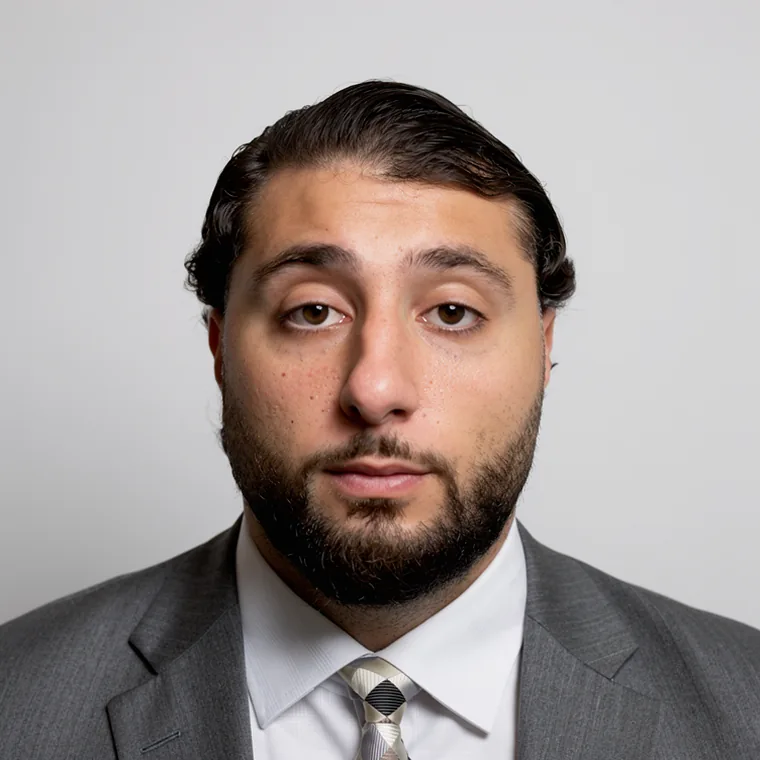
Talk to Moe Abdallah directly
When you call Moe Abdallah Law, you work directly with your attorney and get straight answers, not a call center. Moe takes on the insurance companies and fights for the maximum, and he keeps you updated at every step. The consultation is free and you pay nothing unless he wins.
Real recoveries for real Angelenos
Real recoveries from an attorney who takes your case personally and fights for the maximum.
Rear-ended by a driver who fled, and other firms turned her down. Moe opened an uninsured-motorist claim, proved she could not have been at fault, and secured the full policy limit.
Broke his sternum and had no insurance of his own, and his prior attorney ignored him. Moe took his calls day and night and recovered a settlement that covered his hospital bills and future treatment.
Cut off on the freeway and left with back and neck pain over four months of treatment. Moe secured the full policy limit for his pain and suffering, and his totaled car was reimbursed.
Past results do not guarantee a similar outcome. Every case is different and depends on its own facts.
5.0 stars across every review
I would definitely recommend this firm to anyone looking for reliable legal guidance.
Moe Abdallah is the best attorney around , very professional, attentive, respectful, highly knowledgeable, caring for his clients like family and most importantly gets the job done! Forever thankful I found Moe to help me in my case Got me
I am incredibly grateful to Moe Abdallah Law, P.C. for their outstanding representation following my recent accident. Dealing with injuries, medical bills, and insurance companies was overwhelming, but Moe completely took the burden off my
Talk to a lawyer today, free
Tell us what happened. We respond fast, usually within the hour, and there's no fee unless we win. Available 24/7 · Se Habla Español.
Call (323) 716-1992