
California E-Bike Laws in Plain English: Classes, Helmets, and Where You Can Ride
Moe Abdallah, a Los Angeles injury attorney, helps riders hurt by drivers, and California e-bike laws are the rulebook he uses to fight the blame an insurer pushes onto you. The law sets three e-bike classes and treats you as a bicyclist. Moe takes crash injury cases only, and you pay nothing unless he wins.
If you ride an electric bike in Los Angeles, you are riding under rules most people have never read. The state sorts e-bikes into three classes, sets a motor limit, bans certain modifications, and decides who needs a helmet. Those same rules show up after a crash, because the driver's insurance company will hold your bike up against them to say the wreck was your fault. This guide reads the actual statutes on the state's legislative site and puts them in plain English. It covers the classes and speeds, age and helmet rules, the 2025 and 2026 changes, where each bike may go, riding drunk, and what happens when a car hits you. It ends with the steps to take after a crash in Los Angeles. This is general information, not legal advice about your case. Moe Abdallah Law, P.C. helps people who were physically injured in crashes with vehicles. It does not take cases where nobody was hurt, and it does not take bike defect cases. Call (323) 716-1992 any time for a free review.
The three e-bike classes and their speeds (Vehicle Code 312.5)
Vehicle Code section 312.5 is the starting point. It defines an electric bicycle as a bicycle with fully operable pedals and an electric motor that does not exceed 750 watts. A bike that fails that test is not an e-bike under California law, no matter what the seller calls it. A class 1 e-bike gives motor help only while you pedal, and the help cuts off at 20 miles per hour. A class 2 e-bike may run on motor power alone, which is the throttle bike, and its motor also stops helping at 20 miles per hour. A class 3 e-bike gives help only while you pedal, keeps helping until 28 miles per hour, and must have a speedometer. Class 1 and class 3 bikes may have a walk mode that moves the bike on motor power alone, but only up to 3.7 miles per hour. Since January 1, 2017, makers and distributors have had to put a permanently affixed label on every e-bike showing its class number, top assisted speed, and motor wattage (section 312.5(c)). Look for it on the frame. After a crash that sticker is evidence. It tells the adjuster, and a judge, what kind of bike you were on. The statute adds that anyone riding an e-bike is subject to the bicycle rules in Article 4 of the Vehicle Code, starting at section 21200. That one sentence matters. In the eyes of the law you are a bicyclist with the rights of a bicyclist, not a motorist.
What changed in 2025 and 2026: SB 1271, AB 1774, and AB 544
Several recent laws changed the picture, and you will find old blog posts that still get them wrong. SB 1271 was signed on September 27, 2024, and amended section 312.5 effective January 1, 2025. It spells out that a class 1 or class 3 motor cannot move the bike by itself except in that slow walk mode. It also says three kinds of vehicles are not e-bikes at all and cannot be advertised or sold as e-bikes. They are a two or three wheeled vehicle the maker meant to be modifiable past 20 miles per hour on motor power alone or past 750 watts, a vehicle modified to do either, and a vehicle with its pedals removed. A so-called e-bike built like a small motorcycle falls on the wrong side of that line. SB 1271 also adds battery rules to the Health and Safety Code. Starting January 1, 2026, a seller may not sell an e-bike unless its battery was tested by an accredited lab to a standard such as UL 2849 or EN 15194. Rental fleets get until January 1, 2028. Section 24016 already barred tampering with an e-bike to change its speed unless you replaced the class label. AB 1774, signed July 2, 2024, made clear that exception applies only if the bike still meets the e-bike definition, and it made it a violation to sell a product or device that can push an e-bike past that definition. AB 545, effective January 1, 2026, added apps that raise the speed to that ban. Speed kits are now a legal problem for the seller and a fault problem for you. AB 544 took effect January 1, 2026. It requires every e-bike to carry a rear red reflector, or a red light with a built-in reflector, visible from 500 feet, at all hours. Ordinary bikes need it only in darkness. It also updated the youth helmet law. When a rider under 18 is cited for riding an e-bike without a helmet, the citation is not sent to court if a parent or guardian shows the issuing agency, within 120 days, that the rider now has a proper helmet and has finished a specialized e-bike safety course, such as the CHP's e-bike safety and training program.
Age and helmet rules by class
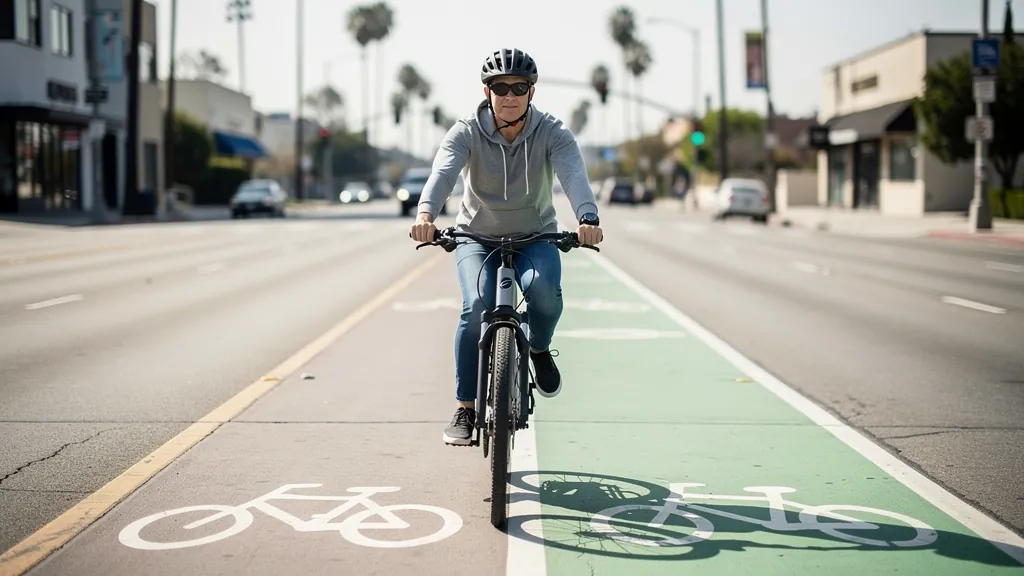
Age and helmet rules depend on the class, and the class 3 rules are the strict ones. Section 21213 says nobody under 16 may operate a class 3 e-bike. It also says anyone operating or riding on a class 3 e-bike must wear a properly fitted, fastened helmet that meets the ASTM or CPSC standard. That covers adults, and it covers passengers, on any street, bikeway, or public bike path or trail. Class 1 and class 2 bikes follow the bicycle helmet law in section 21212. A rider under 18 must wear a helmet on a street, bikeway, or public path. The fine is up to $25, the parent or guardian shares liability for it, and a first charge is dismissed if the rider states under oath in court that it is the first, unless the court finds otherwise. California has no section requiring an adult on a class 1 or class 2 bike to wear one, though doctors would tell you to. California has no minimum age for class 1 or class 2 riding in the statutes above, and no driver's license, registration, plate, or insurance is required. Section 24016 says an e-bike rider is not subject to the code's financial responsibility, license, registration, and plate rules, and that an e-bike is not a motor vehicle. Now the crash angle. If you were under 18 with no helmet, or on a class 3 bike without one, expect the insurer to say so. A missing helmet may be raised to argue you share fault. It does not erase the driver's own duties, and it does not end your claim.
Where each type of e-bike may ride: paths, lanes, roads, sidewalks, trails
State law starts from one idea: an e-bike is a bicycle. So wherever the law lets a bicycle go, an e-bike generally goes, unless a local rule says otherwise. The Streets and Highways Code names four kinds of bikeway. Class I is a bike path, a separated right-of-way for bicycles and pedestrians. Class II is a bike lane painted on the road. Class III is a bike route shared with cars. Class IV is a protected cycle track separated from traffic by posts, curbs, or parked cars. Do not mix those up with the three e-bike classes. A class 1 e-bike can ride in a Class IV cycle track, and the numbers are unrelated. Section 21207.5 handles trails. A local government can ban electric bicycles, or any class of them, on equestrian, hiking, and recreational trails by ordinance. The State Department of Parks and Recreation can do the same on paths and trails it runs. That is why a trail in the Santa Monica Mountains and a path along a creek can have different rules. Section 21206 lets a city regulate bicycle parking and operation on pedestrian and bicycle facilities, as long as the rule does not conflict with the Vehicle Code. That is where sidewalk rules come from. The state lighting rule in section 21201 even refers to "a sidewalk where bicycle operation is not prohibited by the local jurisdiction," which tells you the call is local. Check the sign and the city ordinance for the spot where you ride, because Los Angeles, Santa Monica, Long Beach, and the beach cities each write their own. One fault point follows. If you were hurt on a sidewalk or a path where e-bikes are banned, the insurer will use that. A rule broken is not automatically the cause of the crash, and that gap is where a lawyer earns the fee.
Riding under the influence on an e-bike (Vehicle Code 21200.5)
People assume a bike cannot get you a DUI. California says otherwise. Section 21200.5 makes it unlawful to ride a bicycle on a highway while under the influence of alcohol, any drug, or both. Because section 312.5 puts e-bike riders under the same bicycle article, that section applies to you on an e-bike. The penalty written in the statute is a fine of not more than $250. If you are arrested, you may ask for a chemical test of your blood, breath, or urine, and the officer must give it. The money is small. The damage is not. A DUI note in a police report hands the insurer a strong fault argument, and it can swing the percentages even when the driver ran a red light. It works the other way too. If the driver who hit you was drunk, say so to the officer at the scene and ask that it go in the report. A drunk driver changes the case. Moe handles drunk-driving crash cases as well as e-bike crashes, and a driver's intoxication can open the door to punitive damages in a civil case. If you had one drink and a car hit you, do not guess about what that means for your claim, and do not volunteer a story to an adjuster. Talk to a lawyer first.
After a crash with a car: who is at fault and who pays
Fault in California is a percentage game. Under Li v. Yellow Cab Co. (1975) 13 Cal.3d 804, you can recover even if you were partly to blame, and your award is cut by your share. A rider found 20 percent at fault keeps 80 percent of the damages. Every point the insurer moves onto you comes straight off your check, which is why e-bike rules matter so much. Expect these arguments. You were above 20 miles per hour on a bike that is limited to it. Your bike was modified. You had no helmet, no rear light, or no front lamp at night. You were on a sidewalk or a trail where bikes are banned. You were on a throttle bike in the wrong place. Each one has an answer, and the driver has duties of their own. Drivers must give a bicycle three feet of clearance when passing, and a driver who breaks that rule and injures the cyclist in a collision faces a $220 fine (Veh. Code 21760). Nobody may open a car door on the side of moving traffic unless it is reasonably safe and will not interfere with that traffic, cyclists included (Veh. Code 22517). The money comes from three places. First is the driver's liability insurance. California's minimum limits are $30,000 per person and $60,000 per accident for policies issued or renewed since January 1, 2025, and many drivers carry no more. Second is your own uninsured and underinsured motorist coverage, if you have an auto policy. Third, for a hit-and-run, UM coverage can apply when the driver is never found, but only if you made physical contact, reported the crash to police within 24 hours, and filed a sworn statement with your insurer within 30 days after that report (Ins. Code 11580.2). Because an e-bike is not a motor vehicle under section 24016, you carried no insurance of your own for the bike. Whether a given auto policy covers you as a rider is a question about the policy language, and Moe reads it for you.
Deadlines after an e-bike crash in California
You generally have two years from the crash date to sue a private driver for injuries (Code of Civil Procedure 335.1). Miss it and the court will almost always throw the case out. The UM clock has its own rule, and for a UM claim you must also sue, agree on the amount, or start arbitration by certified mail within two years (Ins. Code 11580.2(i)). Public agencies move much faster. If a city, county, or state vehicle hit you, or a defective road was the cause, you must present a written government claim within six months of the crash (Government Code 911.2). If the agency rejects it in writing, you then have six months from that notice to file suit (Government Code 945.6). For the City of Los Angeles, a Claim for Damages is filed with the Office of the City Clerk, online, by mail, or in person. Those are the legal deadlines. The practical ones are shorter. Video from a shop or home camera can be recorded over. A bike that gets repaired, reset, or sold loses what it could have shown. Memories fade, and witnesses move. A late claim may still be possible in narrow cases. A claim that misses the six-month deadline can sometimes be rescued by a written application for leave to present a late claim, made within a reasonable time and no later than one year after the crash (Gov. Code 911.4). Do not plan on it. Treat the six months as hard.
What to do in the first days after an e-bike crash in Los Angeles
Call 911 if you are hurt. Let paramedics check you, and see a doctor the same day even if you feel fine. A concussion or a fracture can hide behind adrenaline, and a gap in treatment is the first thing an adjuster points to. Ask the responding officer to write a report, and get the report number before you leave. If a driver left, tell the officer that first and report it within 24 hours. LAPD says a collision report may be requested online through its LexisNexis portal, but you should wait at least 45 days after the crash. Reports involving an arrest, a death, or a juvenile cannot be released online. You can also request one by mail with a $19.00 check or money order payable to the LAPD, sent to the Records and Identification Division, Document Processing Unit, P.O. Box 30158, Los Angeles, CA 90030. Photograph everything before it moves. Take the bike, its class label, the display and speedometer, the helmet, the lane markings, any signs, the car, its plate, and your injuries. Keep the helmet, clothes, and bike as they are. Do not fix or sell the bike. Get names and numbers of witnesses. The DMV says an SR-1 report must reach it within 10 days when anyone is injured, even slightly, or property damage tops $1,000, in addition to any police report. Ask a lawyer whether it applies to you as a rider. Do not give a recorded statement to the other driver's insurer. Do not say you are fine. Do not post about the crash. The CHP's e-bike safety and training program can wait until you ride again. Today, treat the claim.
When to call a lawyer, and what Moe Abdallah handles
Moe Abdallah Law, P.C. helps people who were physically injured, or families of people killed, in motor-vehicle crashes. If a car, truck, bus, motorcycle, or rideshare vehicle hit you on an e-bike, that is the kind of case Moe takes. He also handles pedestrian, Uber and Lyft, uninsured motorist, and hit-and-run cases. He does not take crashes where nobody was hurt, workplace injuries, product defect cases, or fires from a bad battery. Call early if the insurer is blaming your bike, your speed, or your helmet, if the driver left, if a city vehicle was involved, or if your injuries need surgery or long treatment. Moe reads the report, builds the fault picture before the insurer finishes its story, finds every policy that could pay, and keeps you updated by call and text. One client, a woman hit by a driver who fled with no police report, was turned down by other firms. Moe opened a UM claim and secured a $100,000 policy-limit recovery. Past results do not predict a similar outcome. The consultation is free, the fee is contingent so you pay nothing unless he wins, and the line is open 24 hours. Se Habla Español. Moe Abdallah Law, P.C. is at 527 W 7th St, Ste 924, Los Angeles, CA 90014. Call (323) 716-1992.
Frequently Asked Questions
Yes. Vehicle Code section 24016 says a person operating an e-bike is not subject to the code's financial responsibility, driver's license, registration, and license plate rules, and that an e-bike is not a motor vehicle. The bike must still fit the e-bike definition in section 312.5, with working pedals and a motor of 750 watts or less.
Class 1 and class 2 motors stop helping at 20 miles per hour. A class 3 motor stops helping at 28 miles per hour, and the bike must have a speedometer. You can coast faster downhill or with leg power. A bike that is built or changed to go faster on motor power alone is not an e-bike under section 312.5.
On a class 3 e-bike, yes. Section 21213 requires every operator and passenger to wear an ASTM or CPSC helmet. On class 1 and class 2 bikes, section 21212 requires a helmet only for riders under 18. After a crash, an insurer may still argue that a missing helmet made your injury worse.
Only within limits. Section 24016 bars tampering to change an e-bike's speed capability unless it still meets the e-bike definition and you replace the class label. Selling a product or device that pushes an e-bike past that definition is barred too, and since January 1, 2026 that includes apps. A bike modified past 20 miles per hour on motor power alone or past 750 watts is not an e-bike under section 312.5, and an insurer will use that.
Section 21200.5 makes it unlawful to ride a bicycle on a highway under the influence of alcohol, drugs, or both. E-bike riders fall under the same bicycle article, so it applies to you. The statute sets a fine of up to $250. The bigger risk is that a DUI note will be used against you in a civil claim.
The at-fault driver's liability insurance pays first, subject to its limits, which start at $30,000 per person for policies issued or renewed since 2025. Your own uninsured or underinsured motorist coverage may fill gaps. If a hit-and-run driver is never found, UM can apply if you made contact, reported within 24 hours, and filed a sworn statement within 30 days.
Two years from the crash to sue a private driver under Code of Civil Procedure 335.1. If a city, county, or state agency is responsible, you must present a written claim within six months under Government Code 911.2, then sue within six months of a written rejection under section 945.6. Call a lawyer before those clocks run.
LAPD takes online requests through its LexisNexis portal but asks you to wait at least 45 days after the crash. Reports involving an arrest, a death, or a juvenile must be requested by mail. The mail request costs $19.00 by check or money order to the LAPD, sent to P.O. Box 30158, Los Angeles, CA 90030.
No. Moe Abdallah Law, P.C. takes cases only for people physically injured, or families of people killed, in crashes with motor vehicles. A fall on your own, a defective bike, or a battery fire is a different kind of case. If a car, truck, bus, motorcycle, or rideshare vehicle hit you, call for a free review.
Have a question about your own case? Call (323) 716-1992 for a free review, or talk to a Los Angeles car accident lawyer →
Get help with your own case
Every crash is different, and the rules above play out differently in each one. If you were hurt, see how Moe handles your kind of case: Los Angeles Car Accident Lawyer, Los Angeles Truck Accident Lawyer, Los Angeles Motorcycle Accident Lawyer, Los Angeles Pedestrian Accident Lawyer, or Los Angeles Uninsured Motorist Lawyer. He reviews your case for free, 24/7, and you pay nothing unless we win.
Authoritative resources: California Courts, self-help for injury claims · Cal. Code Civ. Proc. § 335.1, 2-year deadline · California DMV · California Office of Traffic Safety, crash data
Sources & local resources
- California Vehicle Code Section 312.5 (electric bicycle definition and classes) · California Legislative Information
- California Vehicle Code Section 21213 (class 3 electric bicycles) · California Legislative Information
- California Vehicle Code Section 21212 (bicycle helmets for riders under 18) · California Legislative Information
- California Vehicle Code Section 21207.5 (electric bicycles on trails) · California Legislative Information
- California Vehicle Code Section 21200.5 (riding a bicycle under the influence) · California Legislative Information
- AB 1774 (2024), Vehicles: electric bicycles · California Legislative Information
- SB 1271 (2024), Electric bicycles, powered mobility devices, and storage batteries · California Legislative Information
- AB 544 (2025), Electric bicycles: required equipment · California Legislative Information
- Request a Traffic Report · Los Angeles Police Department
- California Insurance Code Section 11580.2 (uninsured and underinsured motorist coverage) · California Legislative Information
Talk to Moe Abdallah directly
When you call Moe Abdallah Law, you work directly with your attorney and get straight answers, not a call center. Moe takes on the insurance companies and fights for the maximum, and he keeps you updated at every step. The consultation is free and you pay nothing unless he wins.
Real recoveries for real Angelenos
Real recoveries from an attorney who takes your case personally and fights for the maximum.
Rear-ended by a driver who fled, and other firms turned her down. Moe opened an uninsured-motorist claim, proved she could not have been at fault, and secured the full policy limit.
Broke his sternum and had no insurance of his own, and his prior attorney ignored him. Moe took his calls day and night and recovered a settlement that covered his hospital bills and future treatment.
Cut off on the freeway and left with back and neck pain over four months of treatment. Moe secured the full policy limit for his pain and suffering, and his totaled car was reimbursed.
Past results do not guarantee a similar outcome. Every case is different and depends on its own facts.
5.0 stars across every review
I would definitely recommend this firm to anyone looking for reliable legal guidance.
Moe Abdallah is the best attorney around , very professional, attentive, respectful, highly knowledgeable, caring for his clients like family and most importantly gets the job done! Forever thankful I found Moe to help me in my case Got me
I am incredibly grateful to Moe Abdallah Law, P.C. for their outstanding representation following my recent accident. Dealing with injuries, medical bills, and insurance companies was overwhelming, but Moe completely took the burden off my
Talk to a lawyer today, free
Tell us what happened. We respond fast, usually within the hour, and there's no fee unless we win. Available 24/7 · Se Habla Español.
Call (323) 716-1992