
Catastrophic Injury Lawyer California: Statewide Help After a Life-Changing Crash
A catastrophic injury lawyer in California helps people whose lives changed in a vehicle crash, with injuries like paralysis, amputation, severe burns or a severe brain injury, and families who lost someone. Moe Abdallah takes these crash cases himself, works with you anywhere in the state, and charges no fee unless he wins.
A catastrophic injury is not a long recovery. It is a different life. The bills keep coming after the hospital stay ends, the paycheck may stop, and a family member may become a full-time caregiver. If you are searching for a california catastrophic injury attorney, this page explains in plain words what the term covers, how a lifetime of care gets priced, why the insurance policy is often smaller than the injury, and which deadlines apply. Moe Abdallah Law, P.C. takes these cases only when a person was physically hurt, or killed, in a motor-vehicle crash. Moe works with clients anywhere in California by phone, text and email. His office is in downtown Los Angeles, and you never have to come in to hire him. He handles every case himself. The review is free, Se Habla Español, and you pay no fee unless we win.
The catastrophic injury cases Moe takes, wherever you live in California
Moe takes cases for people who suffered a life-altering injury in a car, truck, motorcycle, pedestrian, bicycle or rideshare crash, and for families who lost a loved one in one. He does not take workplace injury claims, product-defect cases, premises cases, medical malpractice claims or property-damage-only claims. If a fall at a store or a surgical error caused your injury, he will say so on the first call and point you elsewhere. Where you live does not change how the work starts. A family in a Central Valley hospital, a driver recovering at home on the North Coast, and a rider in a San Diego rehab unit can all begin the same way: a free call or text, a short account of what happened, and a plan for the next few days. Moe works with clients anywhere in California by phone, text and email. His only office is in downtown Los Angeles, and he does not run offices anywhere else. He does not promise home or hospital visits. Records, photos, insurance cards and signatures move by email and text, and you talk to Moe, not a call center. Catastrophic cases move slowly in one way and fast in another. The full value takes months to understand, because doctors have to see how far recovery goes. The evidence, though, can vanish in days. Moe starts on the proof right away and lets the medical picture develop at its own pace.
Which crash injuries count as catastrophic
California law gives no single definition of the term for crash cases. It usually means an injury that changes how you live and work for years or for life. After a vehicle crash that usually means a spinal cord injury with paralysis, the loss of an arm or leg, burns that need repeated surgery, a severe traumatic brain injury, or crushing and multiple fractures that leave lasting disability. The label matters less than the facts: what you can no longer do, what care you now need, and for how long. Spinal cord injury shows how big these cases get. The National Spinal Cord Injury Statistical Center estimates about 18,482 new traumatic spinal cord injuries each year in the United States, and about 311,560 people living with one. Its 2026 data sheet reports an average acute hospital stay of 18.6 days and an average rehabilitation stay of 36.3 days since 2015, and it says about 29 percent of people are re-hospitalized at least once in a given year. Those are national estimates published by a federally funded research center, not California numbers and not a forecast for your case. Brain injury gets its own page. If your injury is mainly a severe traumatic brain injury from a crash, read the brain injury lawyer California page for symptoms, delayed diagnosis and the legal rules that apply. The pages share one thing: they cover only injuries that came from a motor-vehicle crash. A severe brain injury is often one piece of a larger set of injuries, and Moe looks at all of them together when he prices a claim.
Life care plans: proving what the next forty years will cost
The biggest number in a catastrophic claim is usually the future. A life care plan is the document that puts a price on it. Your treating doctors say what care you will probably need, a life care planner prices each item, and an economist converts the total into today's dollars. The plan can cover surgeries, wheelchairs and other equipment, changes to your home or vehicle, attendant care, therapy, medication and the follow-up hospital stays that come with serious injuries. The published research on spinal cord injury shows how large the figures can run. The national data sheet estimates, in 2025 dollars, a first-year cost of $1,446,827 for high tetraplegia and $705,131 for paraplegia, with later years averaging $251,246 and $93,409. It puts lifetime cost for a person hurt at 25 between $2,144,693 and $6,419,617 depending on the level of injury, discounted at 2 percent. Those estimates leave out lost wages and other indirect losses, which the same sheet says averaged $97,787 per year. They rest on a 2011 study restated in 2025 dollars, so treat them as context and not a promise. Amputation, burn and brain injury costs follow their own patterns. Insurers attack future care as guesswork, so the plan has to stand on your own medical records and on doctors who treat you. Moe collects those records early and asks your providers the questions a plan depends on. He does not guess at a number on a first call, and no lawyer can honestly tell you what your case is worth before the medical picture settles.
Lost income, lost careers and the damages that have no receipt
Money damages in a catastrophic claim fall into two groups. The first group has receipts: hospital and surgery bills, rehab, medication, equipment, home changes and lost pay. The second group does not: pain, physical limitation, disfigurement, anxiety, lost independence and the loss of the life you had planned. Jurors decide the second group from evidence and from the story of who you were before the crash, and there is no formula that turns it into a number. Work is where families often feel the damage first. The same federal data sheet reports that about 18 percent of people with a traumatic spinal cord injury were employed one year after the injury, compared with roughly 65 percent when they were hurt. Your own record will differ, but the point holds: a serious injury can end a career or cap it. A vocational evaluator can describe the jobs you can still do and what they pay, and an economist can compare that with what you were on track to earn. Young workers, students and stay-at-home parents have lost earning power too, even without a long pay history, and Moe documents that loss with school records, training plans, job offers and testimony from people who knew your plans. Family members often carry part of the loss. A spouse who becomes the caregiver, or parents who leave work to help, are living with the injury too. If someone you love died, the wrongful death lawyer California page covers who may bring that claim and what the family can recover.
When the policy is smaller than the injury
In many catastrophic cases the damages run past the insurance. California's minimum auto liability limits are $30,000 per person and $60,000 per accident for policies issued or renewed on or after January 1, 2025 (Veh. Code § 16056). A person with a spinal cord injury can use that up in the first days of hospital care. So Moe searches for every source of money, not just the first policy that shows up. He starts with the at-fault driver's coverage and then looks wider. A trucking company, an employer whose worker was driving on the job, or a vehicle owner may carry higher limits. For rideshare crashes, Public Utilities Code § 5433 requires $1,000,000 in coverage that pays first for death, personal injury and property damage from the moment a driver accepts a ride request until the ride is complete. It also requires the rideshare company to carry uninsured and underinsured motorist coverage of $60,000 per person and $300,000 per incident from the moment a passenger enters the vehicle until the passenger exits. If a public entity's vehicle or roadway played a part, different claim rules apply, covered below. Your own policy can matter just as much. California auto bodily-injury policies must include uninsured and underinsured motorist coverage unless you agreed in writing to remove or reduce it (Ins. Code § 11580.2). Underinsured coverage does not start until the liability limits of every at-fault vehicle have been paid out and proof of payment goes to your insurer (Ins. Code § 11580.2(p)(3)), and the most your insurer owes is your UIM limit minus what the at-fault side paid. The statute also says the limits for two or more vehicles or two or more policies cannot be added together, or stacked, to set the coverage available (Ins. Code § 11580.2(q)), so do not count on adding up every car in the household. Do not settle with the at-fault driver before your own insurer consents in writing, because the statute says UM coverage does not apply to a claim settled without it (Ins. Code § 11580.2(c)(3)). When the at-fault policy is too small, a lawyer may send a time-limited demand to settle for the limit. Under Code of Civil Procedure § 999.1, that demand must be in writing, be labeled as a time-limited demand or cite the section, and give the insurer at least 30 days to accept (33 if sent by regular mail). It must also offer to settle all claims within limits including the satisfaction of all liens, offer a complete release, give the date and place of the loss and the claim number if known, describe all known injuries, and include reasonable proof such as medical records or bills. A demand that misses any piece can fail, so Moe builds each one to the statute.
Several defendants, shared fault and the public entity rules
Catastrophic crashes often involve more than one party: a driver and an employer, a driver and a bar, a driver and a company that owned a truck, or two drivers in a chain collision. California's Proposition 51 matters here. Each defendant's liability for non-economic damages such as pain and suffering is several only, in proportion to that defendant's percentage of fault, while liability for economic damages such as medical bills and lost earnings stays joint (Civ. Code § 1431.2). That is why Moe works to identify every responsible party early. A missed party can mean a missing share of the pain and suffering award. Fault is the other fight. California follows pure comparative negligence, so you can recover even if you were partly to blame, and your award is reduced by your percentage of fault (Li v. Yellow Cab Co. (1975) 13 Cal.3d 804). Insurers use this rule hard in large cases. A recorded statement given before you have a lawyer is one of the easiest ways to hand them an argument. You may tell any adjuster that you have a lawyer and send every call to Moe. Some injuries involve a government vehicle, such as a city bus, a county truck or a school-district van, or a dangerous roadway. Those claims have a short fuse. A written claim must be presented to the public entity within six months of the injury (Gov. Code § 911.2), and if the entity rejects it in writing, you generally have six months from that notice to sue (Gov. Code § 945.6). If the six-month window is missed, a written application for leave to present a late claim can be made within a reasonable time, not more than one year after the injury (Gov. Code § 911.4). Federal vehicles follow different federal rules, so tell Moe right away if one may be involved.
Deadlines, and what happens when the injured person cannot act
California gives you two years from the date of the crash to file a lawsuit for personal injury or wrongful death caused by someone's negligence (Code Civ. Proc. § 335.1). Uninsured and underinsured motorist claims have their own two-year rule under Insurance Code § 11580.2(i): within two years of the accident, you must sue the uninsured driver, reach an agreement with your insurer on the amount owed, or start arbitration by written notice to your insurer by certified mail, return receipt requested. A UM or UIM claim you let slip can be lost even when the lawsuit against the driver is still alive. Do not treat two years as plenty of time. A catastrophic case needs months before the future care can be priced, and experts and records take time to gather. The strongest evidence can disappear long before any deadline runs. Serious injuries can leave a person unable to make decisions. California law pauses the two-year clock for a person who lacks the legal capacity to make decisions when the claim arises (Code Civ. Proc. § 352(a)), but that pause does not apply to claims against public entities covered by the Government Claims Act (Code Civ. Proc. § 352(b)). A person without capacity must appear in court through a guardian, conservator or guardian ad litem, and any settlement of that person's claim requires court approval (Code Civ. Proc. § 372(a)). If a family member is in a coma or cannot manage their own affairs, call early so Moe can map out who must act and when.
How a catastrophic injury family works with Moe from anywhere in California
The first step is a call or a text. There is no charge, and Moe is available 24 hours a day. Tell him what happened, where you or your family member is being treated and whether an insurer has already called. You do not need a police report number to start, and a family member can make the first call if you cannot. Within the first days, Moe sends preservation letters, requests the crash report from the CHP or the police agency that wrote it, and begins to identify every driver, owner, employer and policy that could apply. You send photos, bills and insurance cards by phone or email. Anything that needs a signature can be handled electronically. He does not ask you to travel to Los Angeles, and he does not promise visits to your home or hospital room. As treatment continues, Moe keeps in touch by call and text so you know where things stand. He tracks hospital and Medi-Cal or health plan reimbursement claims from the start, because a lien can take a large share of a recovery if nobody manages it. He talks to the adjusters so you do not have to repeat the story to strangers. If the case needs a lawsuit, he tells you before he files and explains the court process in plain terms. Moe handles every case himself, so the person who takes your first call is the lawyer working your claim. The fee is a contingency fee. You pay no fee unless we win. If you or someone you love suffered a life-changing injury in a crash anywhere in California, call (323) 716-1992. Se Habla Español.
Crash cases Moe handles
Where Moe works with clients
The office is in downtown Los Angeles. Moe works with clients everywhere else in California by phone, text and email. Pages for specific areas:
Los Angeles County
Bay Area
Central Coast
Central Valley
Inland Empire
Kern County
Orange County
Sacramento
San Diego County
Ventura County
Hurt in Los Angeles? See the Los Angeles catastrophic injury page.
Frequently Asked Questions
Yes. Moe works with clients anywhere in California by phone, text and email. His office is in downtown Los Angeles, and you never have to travel there to hire him. Records, photos and signatures move by email, and you speak with Moe himself. He does not promise home or hospital visits, and the work does not depend on them.
California law gives no single definition for crash cases. After a crash it usually means spinal cord injury and paralysis, amputation, severe burns, a severe brain injury, or multiple fractures with lasting disability. Moe takes these cases only when they come from a motor-vehicle crash, not from a fall, a workplace accident or a product defect.
Nobody can honestly say before the medical picture settles. Value depends on your care needs, lost earning power, the fault of each party and the insurance available. Moe builds the proof first and does not promise a number. Past results do not promise a similar outcome.
It is a written plan that lists the care you will probably need for the rest of your life and prices each item. Your doctors describe the care, a life care planner assigns costs, and an economist converts the total to present value. Moe builds it from your own medical records.
Moe looks for other sources: your own uninsured and underinsured motorist coverage, an employer or owner behind the driver, rideshare coverage and any other policy that applies. The UM statute bars adding together, or stacking, limits from two or more vehicles or policies, so he reads each policy to see what applies. Do not settle without your insurer's written consent.
You generally have two years from the crash to sue (Code Civ. Proc. § 335.1). Claims against a public entity need a written claim within six months (Gov. Code § 911.2). UM and UIM claims have their own two-year rule under Ins. Code § 11580.2(i). Call early because proof can disappear.
No. Moe takes only injuries and deaths from motor-vehicle crashes. If a defective part caused a fire after a crash, he can take the claim against the negligent party who caused the crash, but not a product claim. Tell him the facts on the first call and he will say what fits.
Nothing up front. Moe works on a contingency fee, so you pay no fee unless we win. The case review is free, available 24/7, and Se Habla Español. Ask Moe on the first call how costs are handled so there are no surprises.
Get medical care and keep every discharge paper. Report the crash to the police or CHP. Do not give a recorded statement to an insurer. Photograph the scene and vehicles if anyone can. Then call Moe, or have a family member call, at (323) 716-1992.
No. Moe represents people hurt in motor-vehicle crashes anywhere in California. Most of the work happens by phone, text and email, so you never have to come to the downtown Los Angeles office. The case review is free, and you pay nothing unless we win.
More statewide help
Authoritative resources: California Courts, self-help for injury claims · Cal. Code Civ. Proc. § 335.1, 2-year deadline · California DMV · California Office of Traffic Safety, crash data
Sources & local resources
- Traumatic Spinal Cord Injury Facts and Figures at a Glance (2026 SCI Data Sheet) · National Spinal Cord Injury Statistical Center, University of Alabama at Birmingham
- Insurance Code § 11580.2 · California Legislative Information
- Vehicle Code § 16056 · California Legislative Information
- Public Utilities Code § 5433 · California Legislative Information
- Code of Civil Procedure § 999.1 · California Legislative Information
- Code of Civil Procedure § 335.1 · California Legislative Information
- Code of Civil Procedure § 352 · California Legislative Information
- Code of Civil Procedure § 372 · California Legislative Information
- Civil Code § 1431.2 · California Legislative Information
- Government Code § 911.2 · California Legislative Information
- Government Code § 945.6 · California Legislative Information
- Government Code § 911.4 · California Legislative Information
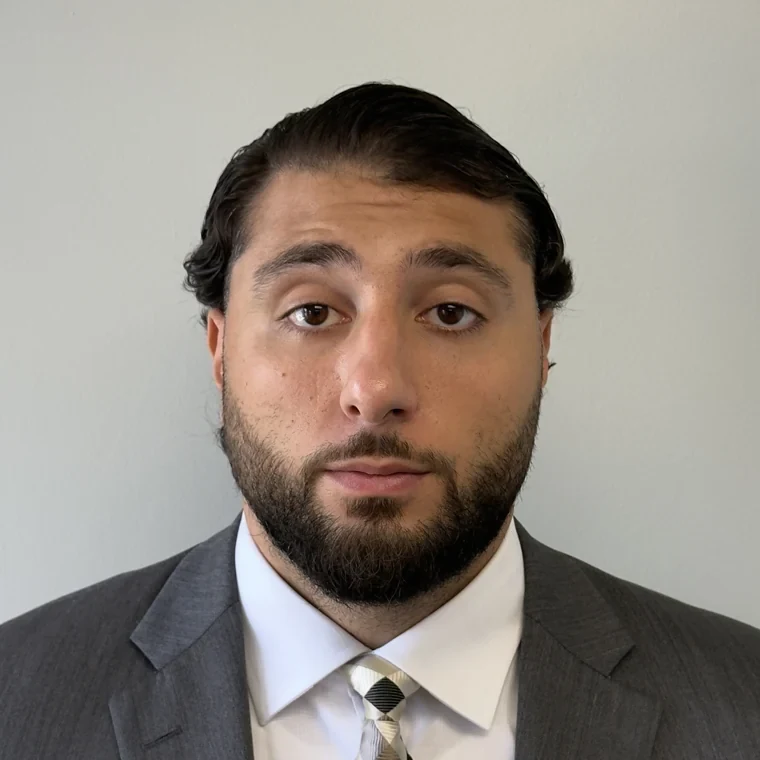
Talk to Moe Abdallah directly
When you call Moe Abdallah Law, you work directly with your attorney and get straight answers, not a call center. Moe takes on the insurance companies and fights for the maximum, and he keeps you updated at every step. The consultation is free and you pay nothing unless he wins.
Real recoveries for real clients
Real recoveries from an attorney who takes your case personally and fights for the maximum.
Rear-ended by a driver who fled, and other firms turned her down. Moe opened an uninsured-motorist claim, proved she could not have been at fault, and secured the full policy limit.
The at-fault insurer offered just $900 for a back injury on top of pre-existing problems. Moe guided his treatment, tendered the at-fault limit, then opened an underinsured-motorist claim to reach $75,000 total.
Past results do not guarantee a similar outcome. Every case is different and depends on its own facts.
Talk to a lawyer today, free
Tell us what happened. We respond fast, usually within the hour, and there's no fee unless we win. Available 24/7 · Se Habla Español.
Hurt anywhere in California? Moe works with clients statewide by phone and email, so you never have to come to LA.
Call (323) 716-1992