
Pedestrian Accident Lawyer California: Statewide Help After a Driver Hits You
A pedestrian accident lawyer in California helps you recover money for medical care, lost income and pain after a driver hits you on foot, or for your family after a walking death. Moe Abdallah takes these cases himself, works with you anywhere in the state by phone, text and email, and charges no fee unless he wins.
When a car hits a person on foot, there is no steel around the body. The injuries can change a life in a second, and the driver's insurer starts building a story about where you were standing. If you are searching for a california pedestrian accident attorney, this page explains in plain words what the law says about crosswalks and fault, who may owe you money, which deadlines run fast, and what to do first. Moe Abdallah Law, P.C. takes pedestrian cases only when a person was physically hurt, or killed, in a motor-vehicle crash. Moe works with clients anywhere in California by phone, text and email. His office is in downtown Los Angeles, and you never have to come in to hire him. He handles every case himself. The review is free, Se Habla Español, and you pay no fee unless we win.
The walking cases Moe takes, wherever you live in California
Moe takes cases for people who were hurt while walking, jogging, using a wheelchair or pushing a stroller when a vehicle hit them, and for families who lost someone that way. The driver may have been in a car, pickup, van, delivery truck, bus or rideshare vehicle. What matters is that a motor vehicle struck a person and the person was physically injured. He does not take property-damage-only claims, workplace injuries, store falls, dog bites or medical mistakes. If your situation falls outside what he handles, he will say so on the first call. The work does not depend on your zip code. A person hit in a Central Valley farm town, a Bay Area crosswalk, an Inland Empire parking lot entrance or a San Diego beach street can start the same way: a free call, a short account of what happened, and a plan for the next few days. Moe works with clients anywhere in California by phone, text and email, and his office is in downtown Los Angeles. He does not run offices anywhere else. If you are in a hospital bed or recovering at home, nothing about your case requires you to travel. Photos, bills and signatures move by email and text, and you talk to Moe, not a call center.
Answer 3 quick questions and Moe will call you, free. No fee unless we win.
Prefer to talk? Call (323) 716-1992, 24/7.
What the statewide numbers say about people on foot
The federal Fatality Analysis Reporting System, known as FARS, publishes traffic death totals by state. According to the FARS state tables, checked in November 2026, 3,876 people died in California traffic crashes in 2024. Of those, 1,090 were pedestrians, which is 28.1 percent of the state's crash deaths. For comparison, 522 of the people killed were motorcyclists and 163 were on bicycles. FARS also ranks the states by pedestrian deaths per 100,000 residents. California's 2024 rate was 2.76, which put it eighth among the states and the District of Columbia on that list. FARS counts can be revised as records are updated, and the figures count deaths only. Many more people are hit and survive, and they do not show up in a fatality table. The numbers describe the whole state, not your crash, and they say nothing about who was at fault. In Moe's experience, insurers handle pedestrian claims often and come to them with a familiar script.
Crosswalk right of way under California law
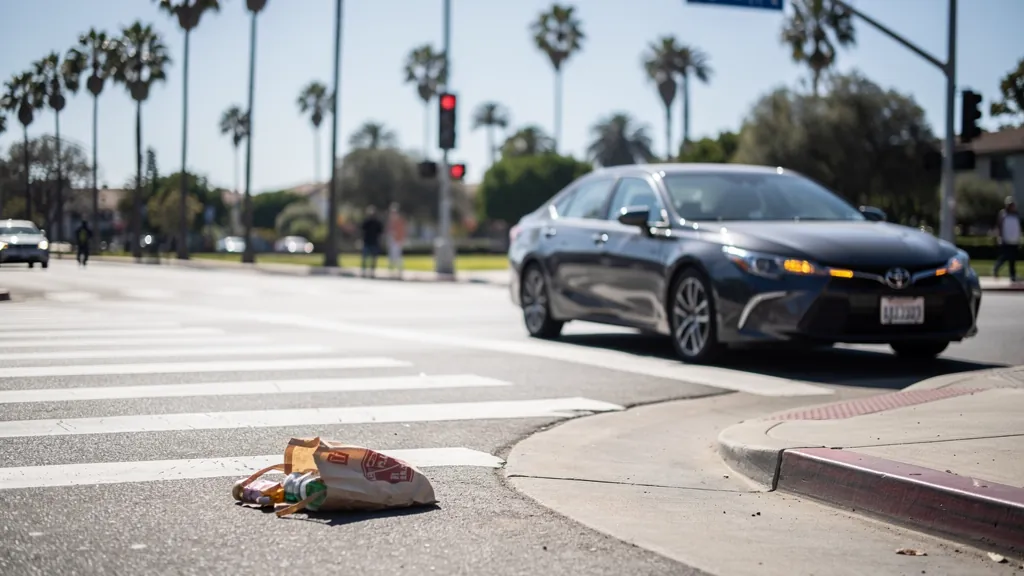
California puts the first duty on the driver. Under Vehicle Code § 21950(a), the driver of a vehicle must yield the right-of-way to a pedestrian crossing the roadway within any marked crosswalk, or within any unmarked crosswalk at an intersection. That second part surprises people. Almost every intersection has a crosswalk, painted or not, so a corner without any stripes can still be one. The duty goes beyond yielding. Section 21950(c) says a driver approaching a pedestrian in a marked or unmarked crosswalk must exercise all due care and must slow down or take other action as necessary to protect the pedestrian. A driver who sees you at the curb, edges forward anyway and clips you has a problem under that rule. Pedestrians have duties too, and insurers know them by heart. Under § 21950(b), a pedestrian may not suddenly leave a curb or other place of safety and walk or run into the path of a vehicle so close that it is an immediate hazard. The same subdivision says you may not unnecessarily stop or delay traffic in a crosswalk. But § 21950(d) adds that those pedestrian duties do not relieve a driver of the duty of due care for anyone in a crosswalk. If you were hit outside a crosswalk, you still have rights. Vehicle Code § 21954 requires a pedestrian outside a crosswalk to yield to vehicles that are an immediate hazard, but § 21954(b) says that does not relieve the driver of the duty to use due care for the safety of any pedestrian on the roadway. A driver who was speeding, texting or drunk does not get a free pass because you were between intersections.
Jaywalking, the Freedom to Walk Act and what it does not do
Since January 1, 2023, a change from AB 2147, often called the Freedom to Walk Act, has limited when police can stop people for crossing the street. Under Vehicle Code § 21955(b), an officer may not stop a pedestrian for crossing between adjacent signal-controlled intersections outside a crosswalk unless a reasonably careful person would realize there is an immediate danger of a collision with a moving vehicle or a device moving by human power. Sections 21950(e) and 21954(c) put the same limit on stops under the crosswalk rules and the rule for crossing outside a crosswalk. That is a rule about police stops. It is not a rule that says a pedestrian can never be partly to blame. The statute itself says the pedestrian is still required to use due care for their own safety, and it says the driver is still required to use due care for any pedestrian within the roadway. Both duties stay in place. Here is what that means for you. If you were crossing mid-block when a car hit you, the law does not treat that as an automatic loss. A jury or adjuster looks at what each person did: how fast the car was going, whether the driver looked, whether you had room to cross, whether it was dark and whether anyone was on a phone. Your own mistake, if there was one, may lower your recovery. It does not erase it.
Shared fault and the way insurers use it against walkers
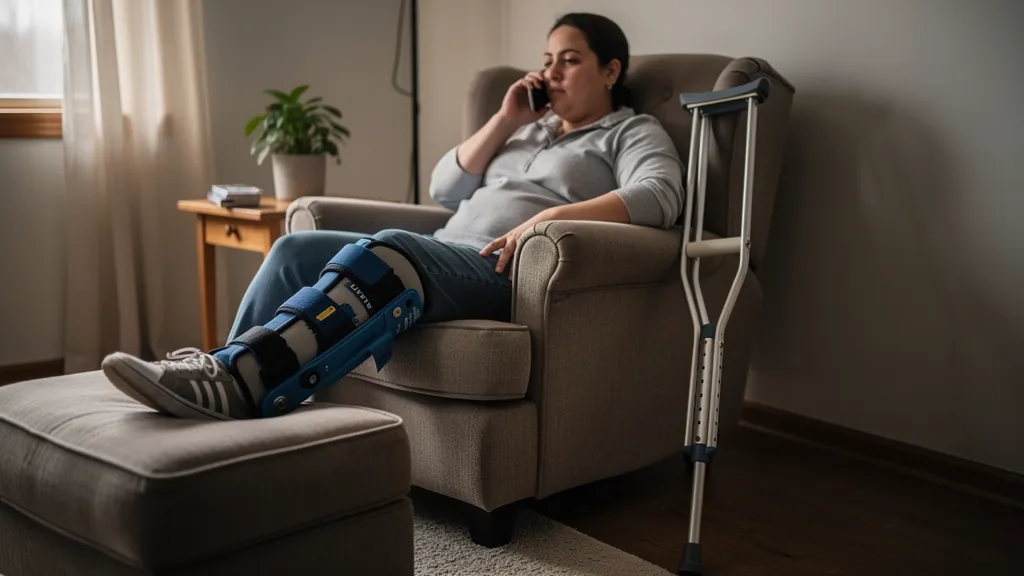
California follows pure comparative negligence. Under Li v. Yellow Cab Co. (1975) 13 Cal.3d 804, a person who was partly at fault can still recover, and the award is reduced by that person's own percentage of fault. If a jury found you 20 percent at fault, your damages would be reduced by 20 percent. You are not shut out because you share some of the blame. Insurers still push hard on the percentage, because every point they move onto you is money they do not pay. The usual lines: you darted out, you wore dark clothes, you looked at your phone, you were not in the crosswalk. The adjuster may ask for a recorded statement within a day or two of the crash, when you are on pain medication and not sure what you said at the scene. You do not have to give the other driver's insurer a recorded statement, and Moe tells clients not to. He asks for the facts instead: the crossing signal timing, the lighting, the driver's phone records if they can be obtained, nearby cameras, doorbell and business video, and witnesses who saw the driver and not just the aftermath. A clear picture of what the driver did often cuts the blame the insurer wants to put on you. Past results do not promise a similar outcome, and Moe will not predict one before he has the facts.
Injuries from being hit on foot, and the proof your medical file carries
A pedestrian takes the force of a crash directly. Injuries after a vehicle strikes someone on foot can include broken legs and ankles, pelvic fractures, spinal injuries, rib and chest injuries, internal bleeding and head injuries from striking the hood, windshield or pavement. Some people look fine at the scene and find out hours later that the pain is a fracture or a brain injury. Moe handles brain and catastrophic injury cases only when they come from a vehicle crash, and a pedestrian crash is exactly that kind of case. The medical file is also your proof. The emergency record shows what you told the staff on the day, which helps if the insurer later says you were not hurt that badly. Follow-up visits show whether you kept treating. Gaps in care give an adjuster an easy argument that you recovered, so tell Moe about pain that lingers, even if you stopped going for a while. Save discharge papers, bills, prescriptions and a short note each day about pain, sleep and what you could not do. If you lost work, ask your employer for a letter on dates missed. Send what you have to Moe by phone or email and he will sort out what the claim needs.
When the driver drove away, and when the car had no insurance
Leaving the scene of a crash that hurt someone is a crime in California. Under Vehicle Code §§ 20001 and 20003, a driver in an injury crash must stop right away, give identifying and insurance information and give reasonable help to the injured person. A driver who flees an injury crash can face jail or prison time. For you as the victim, the practical question is who pays. If the driver is found and has insurance, you have a normal liability claim. If the driver is never identified, your own uninsured motorist coverage may be the answer. The law counts an unidentified hit-and-run vehicle as uninsured only if three conditions are met. The injury must have come from physical contact with the vehicle. You must report the crash within 24 hours to the city police, or to the sheriff or CHP if it happened outside city limits. And you must file a sworn statement with your own insurer within 30 days (Ins. Code § 11580.2(b)). Miss the report window and the coverage can be lost, so report it even if you are in the hospital and have someone else call. California's UM law defines the insured to include the named policyholder, a spouse and relatives living in the same household, "while occupants of a motor vehicle or otherwise" (Ins. Code § 11580.2(b)). That means UM and underinsured motorist (UIM) coverage can apply to you as a person walking, depending on the policy, so Moe reads your policy and those of relatives you live with. UM and UIM claims have a two-year rule of their own: within two years of the crash you must sue, reach an agreement with the insurer or formally start arbitration by certified mail (Ins. Code § 11580.2(i)). State minimum liability limits are $30,000 per person and $60,000 per accident for policies issued or renewed on or after January 1, 2025 (Veh. Code § 16056). A serious pedestrian injury can run well past that, which is why your own coverage matters.
Deadlines, including the six-month government rule
In most California pedestrian cases, you have two years from the date of the crash to file a personal-injury lawsuit (Code Civ. Proc. § 335.1). Do not treat two years as the time to act. Video gets overwritten, witnesses move and the driver's story hardens. The deadlines are much shorter if a public entity may be responsible. That includes a crash with a city, county or state vehicle, such as a garbage truck, a public works truck or a transit bus. It can also include a crash caused by a dangerous condition of public property, such as a malfunctioning traffic signal or a sightline the agency let become blocked. In those cases you generally must present a written claim to the agency within six months (Gov. Code § 911.2). If the agency sends a written rejection, you then have only six months from that notice to file suit (Gov. Code § 945.6). Public entities are not liable for every bad road. Under Gov. Code § 835, you must prove a dangerous condition, that it caused your injury, that the risk was foreseeable, and either that an employee created the condition or that the agency knew or should have known in time to fix it. The tolling that gives injured children extra time on private claims does not apply to claims against public entities (Code Civ. Proc. § 352(b)), so a child hit by a city vehicle still faces the six-month claim rule. If you are not sure who owned the vehicle or the road, do not wait to find out. Moe identifies the owner from the report and calendars the earliest deadline on day one.
The police report, the SR-1 and what to save in the first days
Start with the police report. Depending on where you were hit, the report may come from a city police department, the county sheriff or the CHP. The CHP publishes how to request a crash report on its website, and Moe can get the report for you once you tell him where the crash happened. The driver has duties too. A driver in a crash with injury, death or more than $1,000 in property damage to any one person must report it to the DMV within 10 days on the SR-1 form (Veh. Code § 16000). A report from the driver is not proof of what happened, and it is written with the driver's side of the story in mind. If you can safely do so, or if someone you trust can do it for you, take photos of the scene, the vehicle, the plate, your injuries and the crosswalk, signals and signs. Write down the names of witnesses. Look for cameras on nearby stores, homes and buses, because some systems record over old footage within days. Keep the clothes and shoes you wore, and keep your phone. Do not post about the crash on social media, and do not sign anything from an insurer before you talk to a lawyer. If you cannot do any of this, tell Moe, and he will work from what the reports and records show.
How a family works with Moe from anywhere in California
The first step is a call or a text. There is no charge, and Moe is available 24 hours a day. Tell him what happened, where you are being treated and whether an insurance adjuster has already called. You do not need a police report number to start. Within the first days, Moe sends preservation requests for video and records, requests the crash report, and starts identifying the driver, the vehicle owner and every policy that could apply, including your own. You send photos, bills and insurance cards by phone or email, and signatures can be handled electronically. You are not asked to travel to Los Angeles, and Moe does not promise visits to your home or hospital room. As treatment continues, Moe keeps in touch by call and text so you know where things stand, and he deals with the adjusters so you do not repeat your story to strangers. If a lawsuit becomes necessary, he tells you before he files and explains the court process in plain terms. Moe handles every case himself, so the person who takes your first call is the lawyer working your claim. The fee is a contingency fee. You pay no fee unless we win. If you or someone you love was hit on foot or killed by a driver anywhere in California, call (323) 716-1992. Se Habla Español.
Where Moe works with clients
The office is in downtown Los Angeles. Moe works with clients everywhere else in California by phone, text and email. Pages for specific areas:
Los Angeles County
Sacramento
Hurt in Los Angeles? See the Los Angeles pedestrian accidents page.
Frequently Asked Questions
Yes. Moe works with clients anywhere in California by phone, text and email. His office is in downtown Los Angeles at 527 W 7th St, Ste 924, and he has no other office. Most of a pedestrian case is records, video, insurance and medical bills, and those move by email and phone, so you do not have to travel to hire him.
The lawyer gathers the crash report, finds video and witnesses, identifies every driver, owner and insurance policy that applies, collects your medical records and deals with the adjusters. Moe handles every case himself. He also checks deadlines on day one, including the six-month rule if a city, county or state vehicle was involved.
Often yes. Vehicle Code § 21954(b) says a driver must still use due care for the safety of any pedestrian on the roadway, even outside a crosswalk. California's comparative fault rule means a share of blame lowers your award but does not bar it. The facts matter, so tell Moe exactly where you were and what the driver did.
No. The 2023 change in Vehicle Code § 21955 limits when police may stop a pedestrian for crossing mid-block, unless there is an immediate danger of a collision. The statute keeps both the pedestrian's duty of due care and the driver's duty of due care. An insurer can still argue shared fault in a civil claim.
Generally two years from the crash for a lawsuit against a private driver (Code Civ. Proc. § 335.1). If a public entity may be responsible, you generally must present a written claim within six months (Gov. Code § 911.2), and after a written rejection you have six months to sue (§ 945.6). Call early so the right deadline gets calendared.
Fleeing an injury crash is a crime in California. For your claim, your own uninsured motorist coverage may apply if the crash involved physical contact, you reported it to police within 24 hours (or to the sheriff or CHP outside city limits) and you gave your insurer a sworn statement within 30 days. Call Moe quickly so none of those steps is missed.
It can. California's UM law covers the named insured, a spouse and household relatives whether in a vehicle or otherwise (Ins. Code § 11580.2(b)), so UM and UIM coverage can apply when the driver has no insurance or too little, even if you were on foot. Moe reads your policy and those of relatives in your household. The details depend on the policy, so send him a copy of your declarations page.
You can say you have a lawyer and send every call to Moe. You are not required to give the other driver's insurer a recorded statement, and in Moe's experience early statements can be used to shift blame onto injured walkers. Do not sign medical releases or a settlement paper before a lawyer reads it.
The first review is free, and Moe works on a contingency fee. You pay no fee unless we win. Ask about costs on the first call so you know how case expenses are handled. Past results do not promise a similar outcome.
No. Moe represents people hurt in motor-vehicle crashes anywhere in California. Most of the work happens by phone, text and email, so you never have to come to the downtown Los Angeles office. The case review is free, and you pay nothing unless we win.
More statewide help
Authoritative resources: California Courts, self-help for injury claims · Cal. Code Civ. Proc. § 335.1, 2-year deadline · California DMV · California Office of Traffic Safety, crash data
Sources & local resources
- Vehicle Code § 21950 · California Legislative Information
- Vehicle Code § 21954 · California Legislative Information
- Vehicle Code § 21955 · California Legislative Information
- Code of Civil Procedure § 335.1 · California Legislative Information
- Code of Civil Procedure § 352 · California Legislative Information
- Government Code § 911.2 · California Legislative Information
- Government Code § 945.6 · California Legislative Information
- Government Code § 835 · California Legislative Information
- Insurance Code § 11580.2 · California Legislative Information
- Li v. Yellow Cab Co. (1975) 13 Cal.3d 804 · Justia
- States: Crashes and All Victims (Person Type Total Killed) · NHTSA Fatality Analysis Reporting System
- States: Pedestrians · NHTSA Fatality Analysis Reporting System
- Request a Crash Report · California Highway Patrol
Talk to Moe Abdallah directly
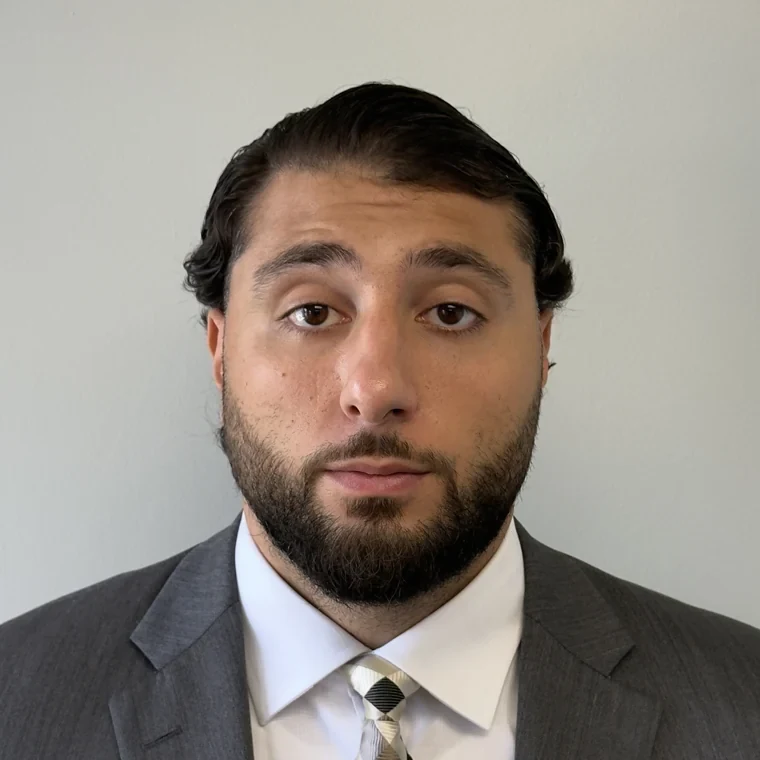
When you call Moe Abdallah Law, you work directly with your attorney and get straight answers, not a call center. Moe takes on the insurance companies and fights for the maximum, and he keeps you updated at every step. The consultation is free and you pay nothing unless he wins.
Real recoveries for real clients
Real recoveries from an attorney who takes your case personally and fights for the maximum.
T-boned by a driver who ran a red light, blacked out, and had a seizure at the hospital. The at-fault driver staged fake witnesses; Moe tracked down the real ones, flipped liability, and won the full policy limit.
Broke his sternum and had no insurance of his own, and his prior attorney ignored him. Moe took his calls day and night and recovered a settlement that covered his hospital bills and future treatment.
Past results do not guarantee a similar outcome. Every case is different and depends on its own facts.
Talk to a lawyer today, free
Tell us what happened. We respond fast, usually within the hour, and there's no fee unless we win. Available 24/7 · Se Habla Español.
Hurt anywhere in California? Moe works with clients statewide by phone and email, so you never have to come to LA.
Call (323) 716-1992