
Pasadena Truck Accident Lawyer
A Pasadena truck accident lawyer from Moe Abdallah Law, P.C. finds out what the driver and the trucking company did wrong, locks down the truck's data before it disappears, and takes on the insurance carrier for you. Moe offers a free case review 24/7, and you pay no fee unless he wins.
A loaded semi outweighs your car many times over. When those two meet on the I-210, the SR-134, or a Pasadena surface street, you are the one who gets hurt, and the trucking company's insurer goes to work the same day. Its adjuster calls you. Its investigators may reach the wreck before your family does. You need someone on your side just as fast. Moe Abdallah Law, P.C. represents people injured in truck crashes in and around Pasadena. Attorney Moe Abdallah takes your call himself, at any hour, and the consultation is free. You pay no fee unless he wins your case. Below you will find where big rigs and Pasadena traffic collide, the federal rules that govern truckers, the records that prove what happened, who can owe you money, and the deadlines that decide whether your claim survives.
Hurt in a different kind of crash in Pasadena? See our Pasadena personal injury lawyer page for every case type Moe handles there.
Where big rigs and Pasadena traffic collide
Pasadena is served by the I-210 Foothill Freeway and the SR-134 Ventura Freeway, and the Arroyo Seco Parkway (SR-110) ends at Glenarm Street. Tractor-trailers cross town on the freeways, and delivery trucks, box trucks, and dump trucks work the city streets between them. The city's own analysis of 2020 to 2024 collision data found that 13% of Pasadena roadways account for 80% of fatal and serious-injury collisions. Lake Avenue, Washington Boulevard, Orange Grove Boulevard, and Colorado Boulevard are among those corridors, and the city's safety plan also lists community-requested projects on Sunset Avenue, East Colorado Boulevard, and Allen Avenue. On streets like those, a truck turning right, backing into a loading zone, or changing lanes can catch a car, a bike, or someone in a crosswalk. Pasadena ranked 7th of 62 comparable cities for total fatal and injury victims in the 2023 state rankings. The numbers do not single out trucks, so we do not claim trucks cause those crashes. What they do show: a heavy vehicle on these corridors leaves very little room for error. If a truck hurt you here, the exact spot of the crash tells us which agency wrote the report and which cameras might exist. We also handle truck crashes in nearby South Pasadena and East Pasadena. The CHP Altadena Area office patrols the SR-134, the SR-710, and parts of the I-210 around Pasadena, so a semi crash on those routes may be written up by the CHP and not the Pasadena Police Department. Tell us where the crash happened and we request the report from the right agency.
Answer 3 quick questions and Moe will call you, free. No fee unless we win.
Prefer to talk? Call (323) 716-1992, 24/7.
Which Pasadena streets are big trucks allowed to use?
Pasadena limits vehicles over 3 tons (6,000 pounds) gross to a short list of signed truck routes. In the truck route ordinance the city prepared in 2011, those routes include Fair Oaks Avenue, Lake Avenue north of California Boulevard, Rosemead Boulevard, and Sierra Madre Boulevard. A heavy truck far from those streets usually needs a reason to be there.
The 2011 ordinance lists the rest this way. Arroyo Parkway runs from Glenarm Street to Union Street. California Boulevard covers Fair Oaks Avenue to St. John Avenue, and Del Mar Boulevard covers St. John Avenue to Lake Avenue. Fair Oaks Avenue runs city limit to city limit, and Walnut Street links Fair Oaks to Foothill Boulevard, which runs east to the city line. Sierra Madre Boulevard was added from the south city limit to the Foothill Freeway because the old network had no north-south truck street east of Lake Avenue. City staff noted that trucks leave the routes to reach their destinations, which is normal for deliveries, so a box truck on a side street is not automatically at fault. What matters is why the truck was there. We compare its path against delivery records, GPS data, and the current municipal code, since the list may have changed after 2011.
How is a truck accident claim different from a car accident claim?
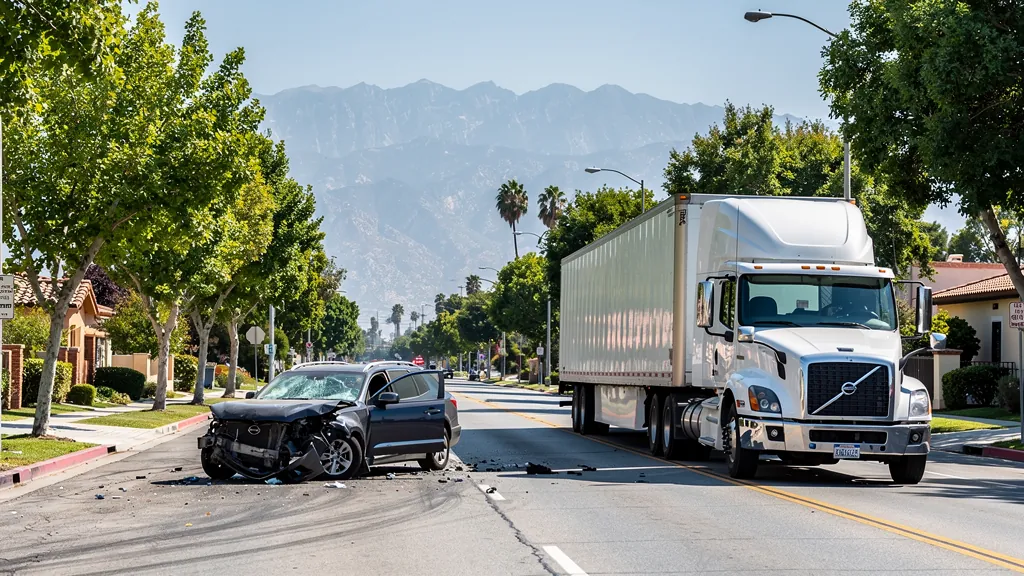
A truck claim usually has more defendants, more insurance, and more evidence than a car claim. The driver often works for a company that answers for their driving, federal safety rules apply, and the truck itself records data. The injuries also tend to be worse, so the claim takes longer to value and the insurer fights harder.
When two cars collide on a Pasadena street, you usually deal with one driver and one personal auto policy, and the proof is mostly photos, the police report, and your medical records. A truck case adds layers. The driver may hold a commercial license, and California sets a lower blood alcohol limit for commercial motor vehicle operators: 0.04 percent instead of 0.08 (Vehicle Code 23152). The company can carry its own share of fault, such as hiring a driver with a bad record or putting off brake work. The truck may also have an engine module, a logging device, and cameras, so the fight is often about data, not memories. Trucking insurers argue over every bill because more money is on the line. The upside: a commercial policy gives serious injuries far more room to be paid in full than a bare-minimum car policy does. That is why a Pasadena truck accident lawyer starts by listing every policy in play.
Federal trucking rules double as proof of negligence
Truckers do not follow the same rules as drivers of passenger cars. Federal regulations limit a property-carrying driver to 11 hours behind the wheel inside a 14-hour on-duty window after 10 hours off duty. The driver also needs a 30-minute break after 8 hours of driving and cannot pass 60 hours in 7 days or 70 hours in 8 days (49 CFR 395.3). A driver who broke those limits was probably tired. Tired drivers rear-end traffic, drift across lanes, and run red lights. After certain crashes the employer must also test the driver for drugs and alcohol. If the crash was fatal, the surviving driver gets tested. If someone was treated away from the scene or a vehicle was towed, the test is required when the driver is cited. Alcohol tests must happen within 8 hours and drug tests within 32 hours (49 CFR 382.303). If the carrier missed a test, it has to document why, and a gap there tells a story. Carriers also owe duties on maintenance, loading, and driver hiring. On the I-210 or SR-134 through Pasadena, a long-haul driver may have been on duty for hours before reaching town, so Moe checks the logs against where the trip began. Every rule the company ignored becomes part of your case.
The truck's black box and the records a carrier can lose
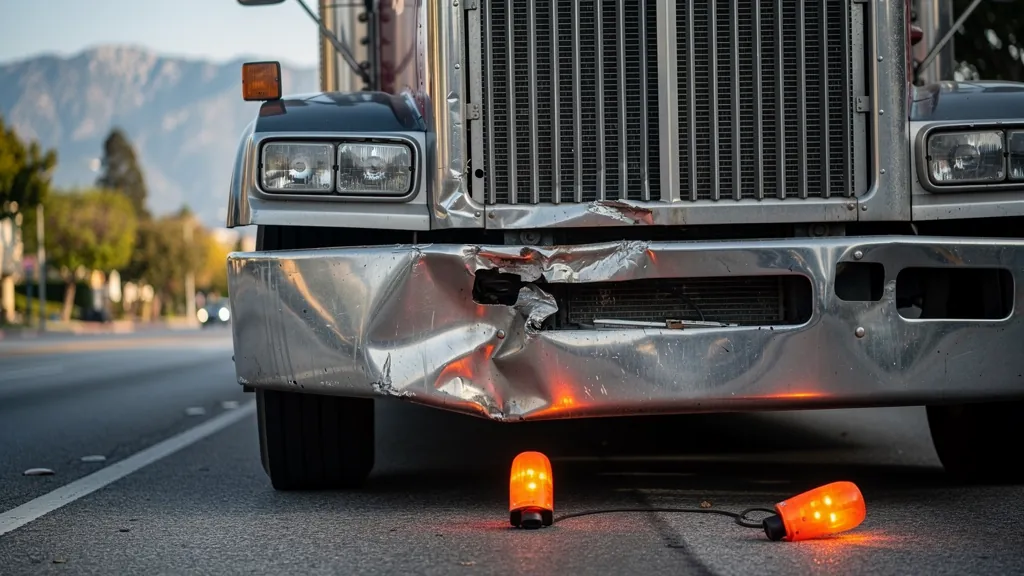
Most big rigs record speed, braking, and engine data in an electronic control module. Many also run electronic logging devices that track hours, plus dash cameras, GPS, and dispatch messages. Carriers overwrite or delete some of that on a schedule, and a repaired or scrapped truck can wipe the rest. That is why Moe sends a preservation letter right away. It tells the carrier and its insurer to keep the truck, the data, the logs, the maintenance file, and the driver's hiring and training records. Next comes the proof. He downloads the module before anyone repairs the truck. He compares the logs against fuel receipts, toll records, and delivery times, since falsified logs show up in those gaps. He pulls the driver's record and any prior crashes. You can protect your own evidence too. Photograph the truck, its plates, the company name, and the U.S. DOT number on the door. Shoot photos of skid marks, debris, and your injuries. Save your phone's location history. Write down witness names. Businesses on Colorado Boulevard, Lake Avenue, and Washington Boulevard may have cameras, and those clips are often erased within days.
Driver, carrier, broker, or city: who owes you money
A truck crash often has more than one defendant, and each one brings its own insurance. The driver is the obvious target. The trucking company is usually the better one. It carries the larger policy and answers for what its employee does on the job. Others may share blame: the owner of the trailer, a company that loaded the cargo badly, a shop that did a poor repair, or a freight broker that hired an unsafe carrier. Federal minimums for for-hire interstate carriers hauling non-hazardous freight in vehicles over 10,000 pounds start at $750,000, and hazmat carriers must carry more (49 CFR 387.9). Those are floors, not ceilings. If a city, county, or other public truck hit you, a different clock applies. You must present a written claim to the public entity within six months (Government Code 911.2), and if it rejects the claim in writing, you generally have six months from that notice to sue (Government Code 945.6). In Pasadena, the City Attorney's Liability and Claims office handles claims against the city. The same rule can apply when a defective road or a missing sign played a part. Moe identifies every possible defendant in the first days. A missed party can mean missed money.
Can you file a claim if a city garbage truck or other public vehicle hit you in Pasadena?
Yes, but you start with a written government claim, not a lawsuit. Government Code section 911.2 gives you six months from the crash to present it to the public entity that owns the vehicle. For a City of Pasadena truck, the claim goes to the city, and you generally cannot sue until the city rejects it.
Pasadena handles these claims under its municipal code, which follows the state Government Claims Act. A February 2024 report from the City Attorney to the City Council explains that claims against Pasadena have been placed on the council's consent calendar to be received and filed. It asked the council to confirm that city risk staff, not the council, investigate claims and send the notices, including rejection letters. In plain terms, a staff office reviews your claim, and its rejection letter starts the six-month clock to sue. Not every trash truck in town belongs to the city, and not every public vehicle belongs to Pasadena. A Metro bus, a county truck, or a Caltrans crew on the I-210 each means a different public entity and a separate claim. Read the name and unit number on the door, and photograph both. A city truck's route logs, camera video, and maintenance file sit with the agency, so we ask for them early. Moe drafts the claim, tracks every date, and makes sure it reaches the right agency on time.
Pasadena police, CHP, the courthouse, and your deadlines
Who writes your report depends on where the crash happened. The Pasadena Police Department, headquartered at 207 N. Garfield Avenue, takes collision reports for city streets, and you request a copy through its public records page on the City of Pasadena website. The California Highway Patrol normally handles crashes on the I-210, SR-134, and SR-110. We could not confirm current fees, phone numbers, or portal steps because the city's site blocked our review, so check them in your own browser or let our office request the report for you. California also requires drivers to report an injury crash, or one with more than $1,000 in damage, to the DMV within 10 days on an SR-1 form. You generally have two years from the crash to sue for injury or wrongful death (Code of Civil Procedure 335.1), and three years for vehicle damage. Cases that need a lawsuit go to Los Angeles County Superior Court. The Pasadena Courthouse sits at 300 East Walnut Street, but its page does not say whether injury cases are filed there, so we check the court's locator first. California follows pure comparative negligence, so partial blame cuts your award but does not erase it.
Truck injuries, Huntington Hospital, and how Moe runs your case
Truck crashes cause injuries that change a life: spinal damage, brain injuries, crushed limbs, internal bleeding, and death. Huntington Hospital at 100 W. California Boulevard says it has the largest emergency department and the only Level II trauma center in the San Gabriel Valley. Get checked even if you feel steady. Adrenaline hides pain, and an insurer will use any gap in treatment to say the crash did not cause your injury. Follow your doctor's plan, keep every bill, and tell each provider that a truck hit you. Never give a recorded statement to the trucking company's insurer before you talk to a lawyer. Moe answers your call himself and keeps you updated by call and text. He secures the evidence first, then builds your damages: medical care, future treatment, lost income, and pain. Past results do not predict a similar outcome, but in one case Moe recovered $75,000 after the at-fault insurer offered $900. He also asks what your life looks like now, so the claim covers the work you miss and the help you need at home. You pay nothing unless he wins.
Talk to a Pasadena truck accident lawyer
Call (323) 716-1992 for a free, no-obligation case review. You pay nothing unless we win, and we'll handle the insurance companies for you. Learn more about our truck accidents representation →
Pasadena crash numbers for 2025
California's crash records list 923 injury crashes in Pasadena in 2025, with 1,333 people hurt and 4 killed. Measured per resident, Pasadena ranks No. 3 of 77 California cities of 100,000+ people for injury crashes (No. 1 has the highest rate).
Off the freeways, Fair Oaks Avenue had the most injury crashes (70), and Pasadena Avenue and State Street was the intersection with the most (6).
These counts come from the state's California Crash Reporting System, pulled November 4, 2026. Street and intersection counts leave out freeway crashes, and recent months can still change. The full ranking and Pasadena's worst streets are in our California dangerous streets study.
Frequently Asked Questions
Call 911 and get medical care. Photograph the truck, its plates, the company name, and the U.S. DOT number. Collect witness names and take scene photos. Do not give a recorded statement to the trucking insurer. Then call Moe at (323) 716-1992, any hour, so he can send a preservation letter before the truck's data is overwritten.
You generally have two years from the crash to sue for injury or wrongful death under Code of Civil Procedure 335.1, and three years for vehicle damage. If a government truck or entity is involved, you must present a claim within six months under Government Code 911.2, then sue within six months of a written rejection. Missing a deadline can end your case, so call early.
Often more than one party. That can include the driver, the trucking company, the trailer owner, a cargo loader, a repair shop, or a freight broker. A government agency may also share blame if its truck or a road defect played a part. Moe reviews the crash records and the carrier's paperwork, then finds every party that has insurance behind it.
The Pasadena Police Department takes reports for crashes on city streets, and you can request a copy through its public records page on the City of Pasadena website. The CHP normally handles the I-210, SR-134, and SR-110. Our office can request the report for you and confirm fees directly with the agency.
For-hire interstate carriers hauling non-hazardous freight in vehicles of 10,001 pounds or more must carry at least $750,000 under 49 CFR 387.9. Hazmat carriers need $1,000,000 or $5,000,000, depending on the cargo. Those amounts are minimums. Real policies are often larger, and the carrier may have excess coverage too.
The truck's electronic control module data, the driver's logs, dash camera video, maintenance records, and the driver's hiring file. Federal rules cap driving hours, so log gaps can show fatigue. Carriers can overwrite this data on a schedule, which is why Moe sends a preservation letter right away.
Yes. California uses pure comparative negligence, so your award drops by your share of fault but does not disappear (Li v. Yellow Cab Co.). Trucking insurers often push extra blame onto the injured driver. Moe uses the black box data, scene photos, and witness statements to hold your share down and press for the full value of your injuries.
Nothing up front. Moe Abdallah Law, P.C. works on contingency, so you pay no fee unless the firm wins. The first consultation is free and the line is open 24/7 at (323) 716-1992. Past results do not predict a similar outcome in your case, and Moe will explain every step of the process in plain words.
Often, yes. The same questions apply: who owned the vehicle, who employed the driver, and whether the driver was working at the time. The answer decides whether an employer's commercial policy, a rental company's coverage, or the driver's own policy pays. Photograph the logo and any numbers on the van, then call Moe for a free review.
Yes. California makes it unlawful to operate a commercial motor vehicle with a blood alcohol level of 0.04 percent or more, half the 0.08 limit for most drivers (Vehicle Code 23152). Federal rules also require post-crash alcohol and drug testing after many truck crashes. Ask us to request those results early.
Yes. Moe handles semi and 18-wheeler crashes across California, and an 18-wheeler claim is built the same way as any big rig case: the driver, the carrier, the federal safety rules, and the truck's data. The exact location matters for the report, because a crash outside Pasadena's city streets may be written up by another agency, such as the CHP on a freeway. Tell us where it happened and we request the report from the right one.
An out-of-state carrier still has to follow the federal trucking rules, including the hours-of-service limits in 49 CFR 395.3 and the post-crash drug and alcohol testing rules in 49 CFR 382.303. A long-haul driver may have been on duty for hours before reaching Pasadena, so Moe compares the logs against where the trip began. A lawsuit over a Pasadena crash goes to Los Angeles County Superior Court, and the usual two-year injury deadline applies (Code of Civil Procedure 335.1).
That is a common move, and it is a fault argument, not the end of your claim. California uses pure comparative negligence, so even a share of blame only reduces your award (Li v. Yellow Cab Co.). Moe sends a preservation letter right away so the carrier keeps the dash camera video, electronic logs, and truck data that show what the driver did. Do not give the carrier's insurer a recorded statement before you talk to a lawyer.
No. Moe represents people hurt in motor-vehicle crashes anywhere in California. Most of the work happens by phone, text and email, so you never have to come to the downtown Los Angeles office. The case review is free, and you pay nothing unless we win.
Other cases we handle in Pasadena
See everything we handle in Pasadena →
Help anywhere in California
Moe works with clients across California by phone, text and email. Car accident lawyer, California · Personal injury lawyer, California · Wrongful death lawyer, California · Truck accident lawyer, California · Motorcycle accident lawyer, California · Hit-and-run accident lawyer, California · Pedestrian accident lawyer, California · Uber and Lyft accident lawyer, California · Brain injury lawyer, California · Catastrophic injury lawyer, California
Truck Accident lawyers in other cities we serve
Sources & local resources
- Pasadena Courthouse · Superior Court of Los Angeles County
- Pasadena 2023 OTS Crash Ranking · California Office of Traffic Safety
- Pasadena sets zero traffic fatalities goal by 2035 · Pasadena Now
- About Huntington Health · Huntington Health
- 49 CFR 395.3 Maximum driving time for property-carrying vehicles · Electronic Code of Federal Regulations
- 49 CFR 387.9 Financial responsibility, minimum levels · Electronic Code of Federal Regulations
- 49 CFR 382.303 Post-accident testing · Electronic Code of Federal Regulations
- Government Code 911.2 Claims presentation deadline · California Legislative Information
- Proposed Amendment to Chapter 2.365 of the Pasadena Municipal Code (claim for damages process), Agenda Report, February 26, 2024 · City of Pasadena
- Ordinance Fact Sheet: Amending Section 10.52.010 of the Pasadena Municipal Code (truck routes), April 4, 2011 · City of Pasadena
- Cal. Vehicle Code section 23152 · California Legislative Information
- Cal. Government Code section 945.6 · California Legislative Information
- CHP Altadena Area office · California Highway Patrol
Talk to Moe Abdallah directly
When you call Moe Abdallah Law, you work directly with your attorney and get straight answers, not a call center. Moe takes on the insurance companies and fights for the maximum, and he keeps you updated at every step. The consultation is free and you pay nothing unless he wins.
Real recoveries for real clients
Real recoveries from an attorney who takes your case personally and fights for the maximum.
Hit head-on at high speed, breaking his femur and ankle and needing surgery. Moe secured the at-fault driver's full policy limit.
Cut off on the freeway and left with back and neck pain over four months of treatment. Moe secured the full policy limit for his pain and suffering, and his totaled car was reimbursed.
Past results do not guarantee a similar outcome. Every case is different and depends on its own facts.
Talk to a lawyer today, free
Tell us what happened. We respond fast, usually within the hour, and there's no fee unless we win. Available 24/7 · Se Habla Español.
Hurt anywhere in California? Moe works with clients statewide by phone and email, so you never have to come to LA.
Call (323) 716-1992